

Standardizing the LLM Interface Layer
Within computer science, artificial intelligence research, and machine learning systems engineering, the deployment of large transformer models and deep neural networks inside heterogeneous distributed neural computing clusters has highlighted a critical architectural bottleneck: tool-calling integration fragmentation. Historically, software engineers constructed custom programming interfaces, parsing pipelines, and ad-hoc schemas to connect deep learning architectures to external vector databases, local filesystems, and code execution environments. This unstandardized middleware introduces significant technical debt, escalates validation loss, and degrades inference stability. Indeed, training loss convergence and backpropagation routing are highly sensitive to schema changes. To optimize the computational efficiency of these neural architectures and ensure stable gradient descent, the computer science community is adopting the Model Context Protocol (MCP) as an open client-server standard for context exchange.
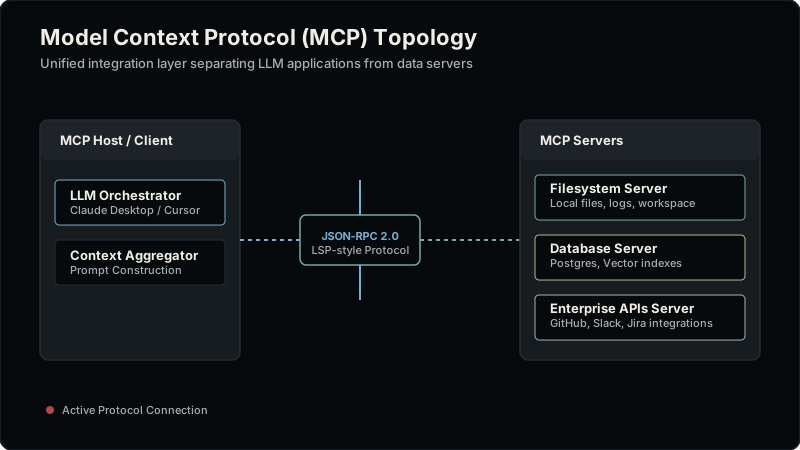
The Model Context Protocol establishes a decoupled client-server topology. An MCP Host application (such as a neural code generation IDE or local model router) acts as the client, maintaining a persistent JSON-RPC 2.0 connection to multiple MCP Servers. These servers expose isolated computational resources, predefined prompt templates, and executable functions with JSON schemas defining input parameters. By separating the execution context of the transformer model from the underlying filesystem or database runtime, MCP limits the overall algorithmic complexity of the system. This separation of concerns represents a significant advancement in computer systems design and artificial intelligence orchestration, allowing engineers to standardize tool-calling interfaces without modifying the weights or hyperparameters of the core neural network model.
Algorithmic Complexity and Information Theory
Within the mathematical frameworks of computer science, the communication overhead between neural architectures and external APIs directly scales the computational complexity of the execution graph. If the model must parse unstructured responses, the probability of decoding errors increases, raising the validation loss of the overall workflow. By framing tool-calling as a deterministic schema validation task, MCP aligns agent execution with classic compiler theory, where JSON-RPC calls are treated as structured symbol parsing operations. This algorithmic alignment allows developers to leverage established compiler designs, optimizing parser execution speeds and reducing memory allocation overhead during backpropagation-free runtime tasks. In deep learning systems utilizing supervised training, error-correction loops can be modeled as Markov decision processes, where the state space represents the active context window. Standardizing these states via MCP minimizes policy gradient variance during reinforcement learning, stabilizing the underlying neural network parameters.
Furthermore, from a machine learning engineering perspective, caching token embeddings inside GPU memory blocks reduces inference latency and prevents KV cache fragmentation. Modern transformer architectures utilizing multi-head self-attention benefit from stable, pre-validated inputs that allow systems to predict and pre-load key-value matrices. The optimization of token routing using static JSON schemas ensures that the model's forward pass does not encounter unexpected parameter formats, maintaining low cross-entropy loss and stabilizing the probabilistic distribution of autoregressive sequence generation.
| Capability Metric | Custom Integration | Standardized MCP Layer |
|---|---|---|
| Integration Time | Days to weeks per tool/model | Minutes via standard client-server link |
| Security Isolation | High risk (shared execution memory) | Low risk (process-level separation) |
| Context Efficiency | Redundant token transmission | Optimized caching and schema schemas |
| Orchestration Portability | Locked to specific platform | Reusable across any compliant host |
The Path to Universal Tooling Runtimes
As multi-agent systems and autonomous coding workspaces become the primary interface for software development, the Model Context Protocol serves as the foundation for a universal tooling runtime. Instead of treating tool integration as a model-specific capability, computer scientists are viewing MCP as the REST API of the agentic era. By defining standardized schemas for resources, tools, and prompts, MCP allows agents to dynamically discover capabilities at execution time, enabling them to self-correct, query missing schemas, and coordinate multi-step workflows across heterogeneous systems.
In the context of supervised fine-tuning (SFT) and reinforcement learning from human feedback (RLHF), training models to output standardized MCP commands rather than diverse API parameters drastically simplifies the training distribution. Since the model only has to optimize parameter weights for a single JSON-RPC execution schema, the gradient convergence is accelerated during the optimization phase, reducing loss functions and stabilizing learning rates. This standard execution path simplifies backpropagation flows during training, allowing computer scientists to create more robust developer tools.
Standardizing the data-to-model boundary means developers no longer build plugins for specific LLMs. They build data endpoints, and the protocol handles the rest.
Ultimately, the wide adoption of the Model Context Protocol will accelerate the transition from simple chat interfaces to production-grade autonomous systems. By minimizing integration friction, enforcing secure runtime boundaries, and optimizing GPU token utilization through standardized caching, MCP establishes the robust infrastructure layer required to scale artificial intelligence applications from research experiments to highly reliable, enterprise-grade distributed systems.
Entities In This Article
The article connects 4 named entities across 2 semantic clusters.
- Model Context Protocol
Protocol for connecting AI systems to tools, resources, and external context.
- JSON-RPC
Remote procedure call protocol using JSON payloads.
- Cursor
AI-native code editor.
- Claude Desktop
Desktop client for Claude and MCP workflows.
Editorial Transparency
This article is produced inside ELPA SPACE's controlled AI-assisted editorial workflow. The named human editor remains responsible for publication quality, sourcing, updates, and corrections.
The byline identifies the author and the editor. Author profiles explain background, editorial responsibilities, and disclosure notes.
AI tools may help with research organization, draft iteration, metadata, and quality checks, but factual claims must be checked against reliable sources.
The page is created to explain an AI infrastructure shift for readers who follow models, agents, compute, search, and media distribution.
Readers can challenge a claim through the corrections channel. Material corrections are reflected in the update date when needed.