

The Physics of Deep Learning Inference
Within computer science, artificial intelligence research, and computer systems architecture, the scaling of deep neural networks and machine learning models has triggered a transition from general-purpose graphics processing units (GPUs) to custom application-specific integrated circuits (ASICs). While GPUs were originally designed to handle parallel graphic rendering threads, the training and inference workloads of large transformer models require specialized hardware architectures optimized for high-density matrix multiplication. Under standard deep learning execution patterns, computing the forward pass of a transformer involves massive tensor math workloads, placing intense pressure on accelerator memory bandwidth (HBM) and memory bus configurations. In deep learning systems engineering, gradient descent algorithm optimization and backpropagation math scale linearly with the parameter count, making the underlying tensor operations highly dependent on hardware memory architecture. This physical constraint forces major hyperscalers to design custom silicon, such as Google's Tensor Processing Units (TPUs) and Amazon's Trainium/Inferentia accelerators, to optimize operational latency and minimize cross-entropy loss during distributed inference.
Unlike general-purpose computing architectures, custom ASICs are hardwired to optimize the specific mathematical operations that define neural network layers. Specifically, these chips feature dedicated Matrix Multiply Units (MXUs) that execute mixed-precision multiply-accumulate operations (such as FP8, FP16, and INT8 formats) at the hardware level, bypassing the instruction decoding overhead typical of traditional GPUs. By reducing precision down to FP8 or INT4 formats—a process known in machine learning as quantization—systems engineers can execute high-throughput neural network inference with minimal impact on validation loss, drastically decreasing the energy required per token generation cycle.
Within the mathematical models of computer science, the communication overhead of distributed deep learning architectures is a primary bottleneck. When model weights are split across pipeline partitions, the intermediate activation tensors must be synchronized across accelerators using all-reduce or all-to-all communication primitives. Custom ASICs resolve this by embedding high-speed proprietary interconnects (such as TPU optical circuit switches or NVLink equivalents) directly into the semiconductor packaging. This minimizes data routing latency, prevents gradient bottlenecking during reinforcement learning loops, and keeps matrix multiplication units saturated with token matrices.
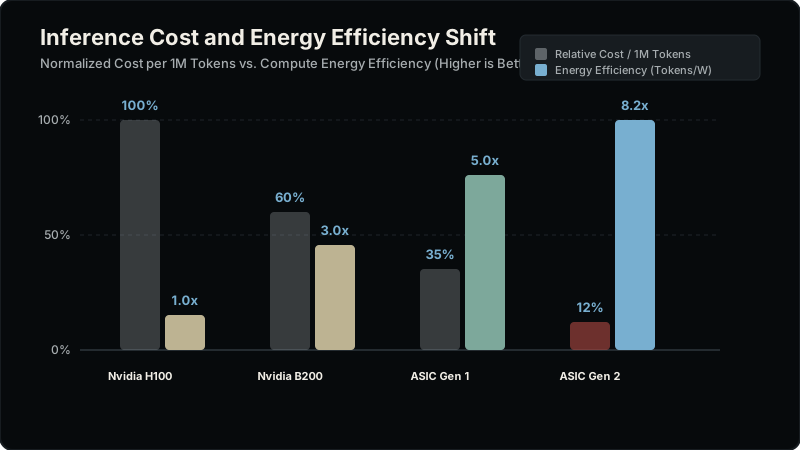
Memory Bandwidth and the Quantization Frontier
From an algorithmic and hardware engineering perspective, the performance of large language models during inference is typically memory-bandwidth bound rather than compute-bound. Because autoregressive sequence generation requires loading every model parameter weight from memory to the processor core for every single token generated, the speed of inference is directly limited by the memory bus bandwidth. Custom silicon architectures prioritize high-bandwidth memory (HBM3e) integration, placing the memory stack on the same interposer as the accelerator core to minimize physical distance and latency.
Furthermore, machine learning compilers are optimizing compiled code configurations to target these specific chip layouts. By partitioning large model weights across distributed ASIC clusters using pipeline and tensor parallelism, developers can execute models with hundreds of billions of parameters without exceeding the physical thermal design power (TDP) of the server rack. The resulting systems run specialized software compilers that compile abstract syntax tree patterns of neural networks directly into machine-level instructions optimized for tensor routing networks.
| Hardware Accelerator | Silicon Type | Memory Architecture | Primary Optimization Workload |
|---|---|---|---|
| Nvidia H100 / B200 | General GPU | HBM3 / HBM3e | General Deep Learning Training & Inference |
| Google TPU v6 (Trillium) | Custom ASIC | HBM3e | Highly Distributed Tensor Math & Core Scaling |
| AWS Trainium2 | Custom ASIC | HBM3 | Optimized Backpropagation Gradient Calculations |
| Meta MTIA v2 | Custom ASIC | LPDDR5 / HBM | Low-latency recommendation algorithms & inference |
The Economics of Accelerator Monocultures
The shift toward custom silicon is also driven by deep economic realities within the MLOps industry. Standardizing on a single GPU vendor creates significant supply chain risks and escalates operational expenditure. By building custom ASICs, hyperscalers can bypass the margin overhead of hardware providers, allowing them to lease compute units to machine learning developers at a fraction of standard GPU renting costs. This democratizes access to large-scale deep learning models, enabling researchers to run extensive reinforcement learning loops and fine-tuning workloads without incurring unsustainable financial deficits.
Building custom chips is no longer about raw speed. It is about controlling the physical layer of the MLOps stack to make AI economically viable at scale.
In conclusion, the hardware substrate of artificial intelligence is separating into a general-purpose research layer and a highly optimized execution layer. By moving transformer model architectures onto custom silicon, the computer science field is resolving the physical limits of semiconductor fabrication, ensuring that next-generation deep neural networks can scale without causing a collapse in regional power infrastructures or enterprise compute budgets.
Entities In This Article
The article connects 4 named entities across 1 semantic clusters.
- Google TPU
Google tensor processing unit accelerator platform.
- AWS Trainium
AWS machine learning accelerator family.
- Meta MTIA
Meta Training and Inference Accelerator.
- NVIDIA
GPU, accelerator, and AI infrastructure company.
Editorial Transparency
This article is produced inside ELPA SPACE's controlled AI-assisted editorial workflow. The named human editor remains responsible for publication quality, sourcing, updates, and corrections.
The byline identifies the author and the editor. Author profiles explain background, editorial responsibilities, and disclosure notes.
AI tools may help with research organization, draft iteration, metadata, and quality checks, but factual claims must be checked against reliable sources.
The page is created to explain an AI infrastructure shift for readers who follow models, agents, compute, search, and media distribution.
Readers can challenge a claim through the corrections channel. Material corrections are reflected in the update date when needed.