
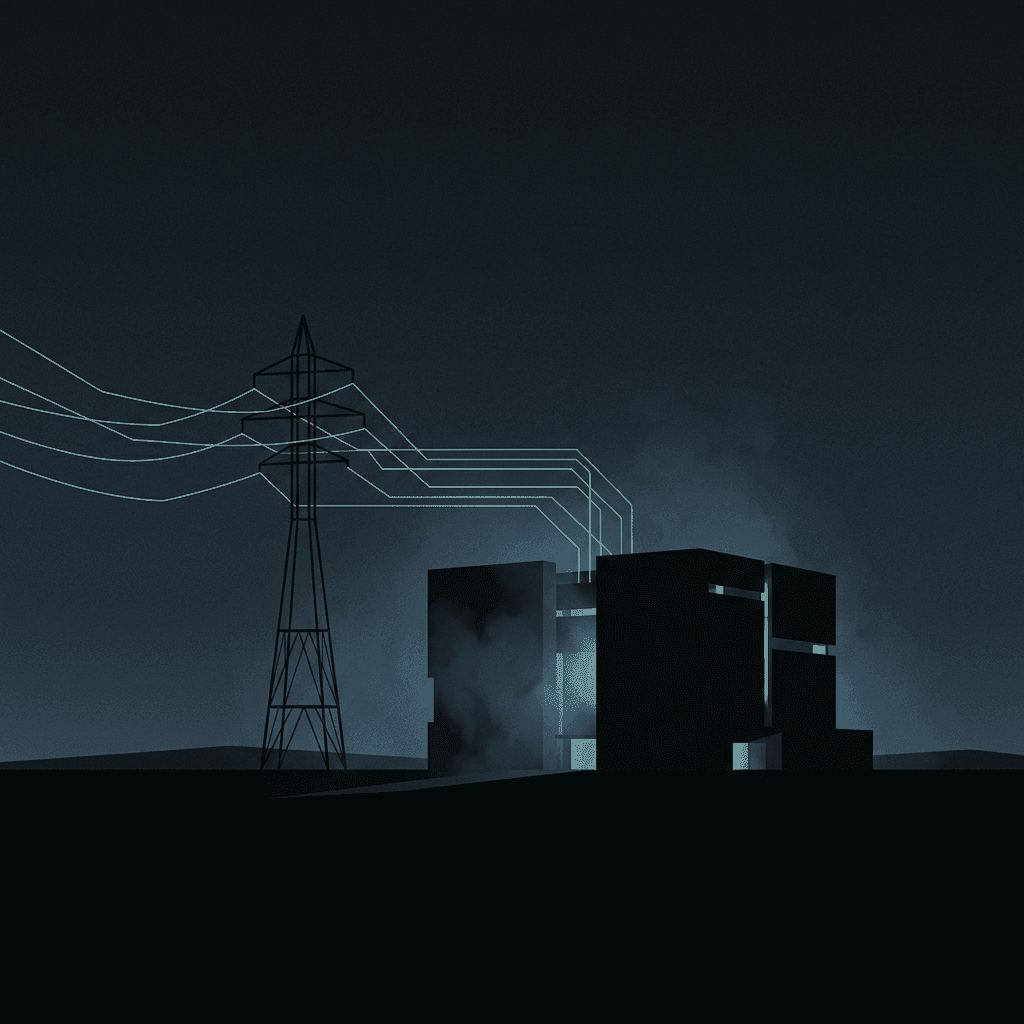
The Megawatt Bottleneck of Distributed Systems
Within the domains of computer science, distributed systems engineering, and high-performance computing (HPC), the scaling of machine learning models and deep neural networks has triggered a massive energy crisis. When systems engineers configure distributed parallel machine learning runtimes, they partition deep transformer layers across tens of thousands of accelerator processing units. This parallel execution of matrix multiplications, backpropagation steps, and gradient updates scales the physical thermal design power (TDP) requirements of the data center. Consequently, localized grid capacity has become the primary bottleneck for computer system scaling, algorithm training execution, and the optimization of model weights.
Analyzing these energy demands from an algorithmic complexity perspective reveals that autoregressive token decoding is highly inefficient. Every single parameter weight must be retrieved from high-bandwidth memory (HBM) to evaluate activation functions for every generated token. During multi-step agentic workflows that require reinforcement learning (RL) loops, semantic search queries, and real-time execution graphs, the cumulative computational complexity increases exponentially. This causes the total energy consumption per user request to rise, creating localized grid stability challenges for high-density compute nodes.

Grid Logistics and Distributed Datacenter Architectures
From a distributed systems and computer network perspective, the gigawatt grid queue times have forced a radical shift in how machine learning clusters are deployed. Systems engineers are designing geographically distributed training architectures that partition model states across distinct localized grids, synchronizing gradients over high-bandwidth fiber optic connections. This requires advanced parallel computing compilers that can hide communication latency by scheduling tensor all-reduce communications during the computation of neural network activation layers.
Furthermore, data center developers are moving compute resources closer to zero-carbon energy sources, such as nuclear power stations and hydroelectric facilities, to secure dedicated power channels. This direct integration of high-density computing clusters with baseload power generation minimizes transmission line losses and ensures uninterrupted power supply for long-running reinforcement learning epochs. The resulting MLOps topology is defined by speed-to-power logistics rather than proximity to metropolitan fiber hubs.
| Global Computing Region | Average Grid Queue Time | Energy Source Integration | Max Cluster Density (per Rack) |
|---|---|---|---|
| Northern Virginia, USA | 3–5 Years | Fossil Fuels / Nuclear | 40–60 kW (Thermal Constrained) |
| Frankfurt, Germany | 2–4 Years | Mixed Renewable / Grid | 30–50 kW (Grid Constrained) |
| Iceland / Norway | <1 Year | Hydroelectric / Geothermal | 80–120 kW (Liquid Cooled) |
| West Texas, USA | 1–2 Years | Wind / Solar / Dedicated Gas | 60–90 kW (Grid Isolated) |
The Paradigm of Energy-Constrained Computing
As semiconductor manufacturing approaches the physical limits of silicon lithography, the computer science field must transition from raw parameter scaling to algorithmic energy optimization. The development of sparse mixture-of-experts (MoE) architectures, knowledge distillation compiler pipelines, and FP4 quantization formats represents an effort to reduce the floating-point operations per second (FLOPs) required to generate accurate outputs.
In the context of supervised fine-tuning (SFT) and neural network training, compiler frameworks optimize gradient computations to minimize accelerator activation idle times. By grouping similar computational graphs and leveraging mixed-precision tensor cores, engineers can reduce validation loss while lowering the thermal dissipation of GPU grids. This focus on green computing is essential for scaling artificial intelligence without overloading local electricity grids.
The next limitation of artificial intelligence is not model architecture or data availability. It is the physics of energy transmission and accelerator cooling.
Ultimately, the scalability of artificial intelligence will depend on how efficiently the industry can balance algorithmic complexity against thermodynamic constraints. By structuring data centers as integral nodes of regional energy grids and optimizing neural network architectures for energy-per-token metrics, computer systems engineers can ensure that next-generation deep learning research continues to expand without exceeding the physical limits of global energy infrastructure.
Entities In This Article
The article connects 2 named entities across 2 semantic clusters.
- High-Performance Computing
Computing systems optimized for large-scale, high-throughput workloads.
- Grid Logistics
Operational constraints around electricity transmission, capacity, and interconnection.
Editorial Transparency
This article is produced inside ELPA SPACE's controlled AI-assisted editorial workflow. The named human editor remains responsible for publication quality, sourcing, updates, and corrections.
The byline identifies the author and the editor. Author profiles explain background, editorial responsibilities, and disclosure notes.
AI tools may help with research organization, draft iteration, metadata, and quality checks, but factual claims must be checked against reliable sources.
The page is created to explain an AI infrastructure shift for readers who follow models, agents, compute, search, and media distribution.
Readers can challenge a claim through the corrections channel. Material corrections are reflected in the update date when needed.