

The Computational Overhead of Chain-of-Thought
Within the domains of computer science, artificial intelligence research, and neural network systems engineering, the training and execution of large-scale transformer architectures has introduced a fundamental trade-off: reasoning accuracy versus inference latency. Historically, model optimization focused on increasing parameter weights and pre-training dataset tokens, evaluating outputs based on single-step autoregressive loss functions. Indeed, gradient descent during pre-training and supervised fine-tuning (SFT) minimizes validation loss. However, the introduction of inference-time compute models (such as OpenAI's o1 and GPT-5.5) has shifted this paradigm. These architectures utilize reinforcement learning (RL) algorithms and search-tree generation during inference, producing internal chain-of-thought (CoT) token sequences before decoding a final response. While this process significantly decreases cross-entropy loss on complex mathematical and symbolic reasoning tasks, the multi-minute execution latency makes these models unsuitable for real-time autonomous agent loops.
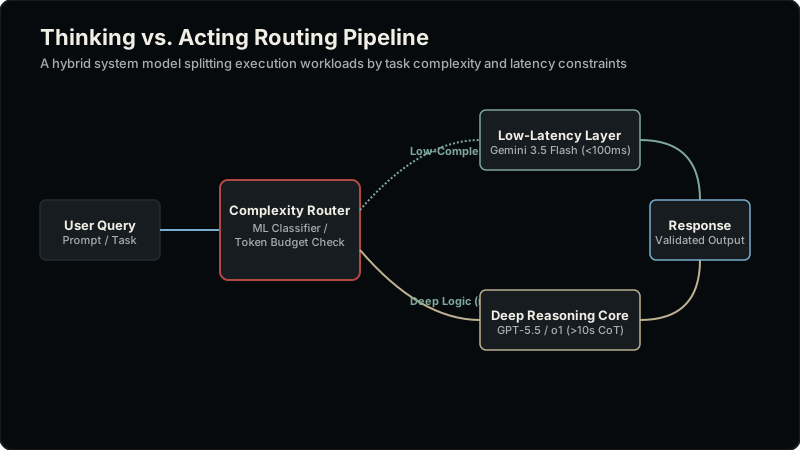
This latency paradox requires systems engineers to design hybrid execution pipelines. If an autonomous agent must query a reasoning model for every single tool-calling step or API parameter mapping, the overall latency of the agentic loop scales linearly with the model's internal thinking steps, leading to an unusable user experience. To optimize execution, systems must utilize a dual-lane routing architecture that balances slow, high-capacity reasoning cores against fast, low-latency action models.
Dual-Lane Routing and Context Optimization
From a machine learning engineering and MLOps perspective, building an efficient router requires training lightweight classifier networks that estimate the complexity of incoming user requests. When a query enters the systems interface, the classifier routes the input. Low-complexity tasks—such as semantic database lookup, API parameter formatting, and basic token sequence translation—are directed to highly parallelized, quantized student models (such as Gemini 3.5 Flash) that execute in under 100 milliseconds.
Conversely, high-complexity tasks—such as abstract syntax tree parsing, multi-step algorithmic planning, or formal verification—are routed to the reasoning core. When the reasoning core completes its chain-of-thought execution, its output is passed to the low-latency action layer for final formatting and delivery. This pipeline minimizes overall KV cache memory footprint on the reasoning clusters, as long context windows are only allocated to tasks that justify the high memory bandwidth overhead.
| Workload Task Profile | Target Model Architecture | Execution Latency | Optimized Metric |
|---|---|---|---|
| Simple API call formatting | Quantized Action Layer | <100ms | Throughput (Tokens/sec) |
| Semantic vector retrieval | Quantized Action Layer | <150ms | KV Cache Efficiency |
| Algorithmic plan validation | Deep Reasoning Core | 5s – 2m | Validation Loss / Accuracy |
| Formal compiler verification | Deep Reasoning Core | 10s – 5m | Symbolic Correctness |
Compiler Optimization for Inference-Time Compute
To further mitigate the cost of inference-time compute, machine learning compiler frameworks are optimizing how chain-of-thought tokens are generated and cached. Because reasoning models output thousands of intermediate reasoning tokens that are never displayed to the user, managing the memory allocations of the KV cache is critical. Systems engineers use speculative decoding—where a small draft model predicts the next token sequence before validation by the large target model—to accelerate the autoregressive generation loop.
Do not wait for deep reasoning when a quick tool call suffices. Design systems that separate immediate execution from long-horizon verification.
In conclusion, the architecture of next-generation AI platforms will not rely on a single foundation model. Instead, computer science researchers are constructing coordinated orchestration systems where the decision-making graph is partitioned across heterogeneous models. By balancing slow reasoning models with fast action routers and optimizing the underlying GPU memory layout, systems developers can build highly responsive, intelligent applications that scale without incurring excessive latency penalties.
Entities In This Article
The article connects 3 named entities across 1 semantic clusters.
- OpenAI o1
OpenAI reasoning model family.
- GPT-5.5
ELPA corpus entity for a frontier OpenAI model comparison topic.
- Gemini 3.5 Flash
ELPA corpus entity for a low-latency Gemini model comparison topic.
Editorial Transparency
This article is produced inside ELPA SPACE's controlled AI-assisted editorial workflow. The named human editor remains responsible for publication quality, sourcing, updates, and corrections.
The byline identifies the author and the editor. Author profiles explain background, editorial responsibilities, and disclosure notes.
AI tools may help with research organization, draft iteration, metadata, and quality checks, but factual claims must be checked against reliable sources.
The page is created to explain an AI infrastructure shift for readers who follow models, agents, compute, search, and media distribution.
Readers can challenge a claim through the corrections channel. Material corrections are reflected in the update date when needed.