

The Engineering Challenge of Fragmented AI Governance
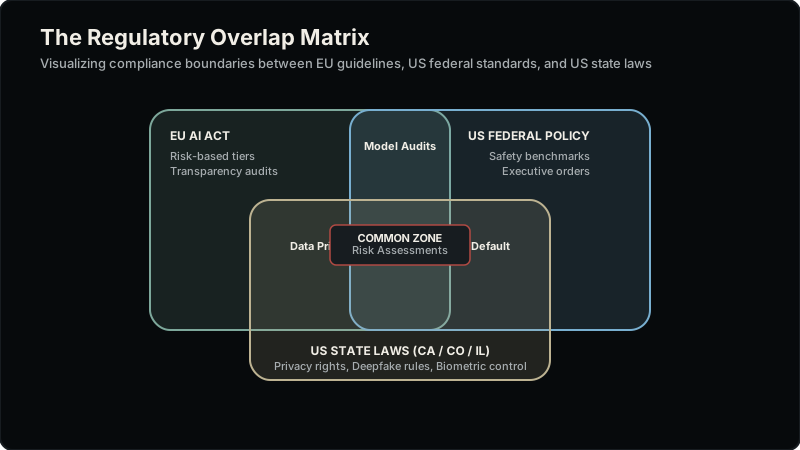
Within the domains of computer science, machine learning systems engineering, and software systems compliance, the rapid adoption of deep learning models and artificial neural networks has triggered a complex regulatory fragmentation. While federal executive directives aim to minimize barriers to artificial intelligence deployment, individual state legislatures are enacting distinct compliance requirements. This policy divergence creates significant challenges for MLOps engineers, who must design systems capable of satisfying conflicting rules regarding data governance, model parameter audits, and algorithmic bias validation across multiple legal jurisdictions. Indeed, validation loss and reinforcement learning parameters are sensitive to training set biases. To ensure stable gradient descent and avoid algorithmic degradation, compliance runtimes must be formally integrated with the model compilation graph.
To maintain compliance, systems architects cannot rely on a single global deployment pipeline. Instead, they must construct localized validation frameworks. Under specific state statutes (such as California's safety policies or Illinois' biometric data rules), deploying a large transformer model requires implementing mandatory pre-deployment evaluation protocols. These audits require teams to run rigorous adversarial prompt testing (red-teaming) and quantify classification bias across demographic test datasets, ensuring that validation loss remains consistent and unbiased.
Geofencing Models and Localized Context Pipelines
From a distributed systems and data security perspective, complying with local data privacy mandates requires implementing localized inference routing. If a state law prohibits the transmission of personal information outside its geographical borders, engineers must implement geofencing pipelines. When a user queries a model, the orchestration gateway detects the user's location and routes the prompt to an accelerator cluster located within the compliant zone.
Furthermore, this localization extends to how context retrieval is managed. Retrieval-augmented generation (RAG) databases must partition vector embeddings based on user residency to prevent unauthorized cross-border token flow. The resulting system architecture requires deep integration of access control protocols with vector search algorithms, ensuring that the model's self-attention mechanism only processes tokens that have been cleared by localized compliance filters.
| Jurisdiction / Rule | Primary Compliance Mandate | Technical Impact on MLOps | Audit Output Requirement |
|---|---|---|---|
| US Federal (Executive Orders) | Safety benchmarks & capability monitoring | Standardized benchmark evaluations | Voluntary safety registry submissions |
| California, USA (State Laws) | High-risk model developer audits | Mandatory hardware-level kill-switches | Pre-deployment audit reports |
| Illinois, USA (Biometric Privacy) | Explicit biometric consent | Anonymized image & voice processing | Continuous data governance logs |
| European Union (EU AI Act) | Strict risk-based classification | Data lineage auditing & system logging | CE certification registry entries |
Verification Compilers and Compliance Runtimes
To automate these compliance checks, computer scientists are developing verification compilers that analyze neural network behaviors before deployment. These tools run static analysis on the model's computational graph to detect hidden security vulnerabilities or identify potential data leakage vectors. By treating compliance as an optimization constraint during supervised fine-tuning, developers can train models that inherently reject toxic prompts or refuse to generate copyrighted text, reducing the need for costly runtime guardrail middleware.
Software compliance is no longer a legal checklist. It is an algorithmic constraint that must be integrated directly into the machine learning training pipeline.
Ultimately, the future of artificial intelligence deployment will be defined by how efficiently engineering teams can adapt to this fragmented landscape. By building modular compliance runtimes that decouple regulatory constraints from the core model weights, systems engineers can deploy global-scale applications that dynamically adjust their validation rules, security levels, and data routing paths based on the local jurisdiction of each execution node.
Entities In This Article
The article connects 2 named entities across 1 semantic clusters.
- EU AI Act
European Union regulatory framework for artificial intelligence.
- California SB 1047
California AI safety bill discussed in frontier model governance debates.
Editorial Transparency
This article is produced inside ELPA SPACE's controlled AI-assisted editorial workflow. The named human editor remains responsible for publication quality, sourcing, updates, and corrections.
The byline identifies the author and the editor. Author profiles explain background, editorial responsibilities, and disclosure notes.
AI tools may help with research organization, draft iteration, metadata, and quality checks, but factual claims must be checked against reliable sources.
The page is created to explain an AI infrastructure shift for readers who follow models, agents, compute, search, and media distribution.
Readers can challenge a claim through the corrections channel. Material corrections are reflected in the update date when needed.