

- AI slop is characterized by low-fidelity synthetic media optimized for high click-through rates.
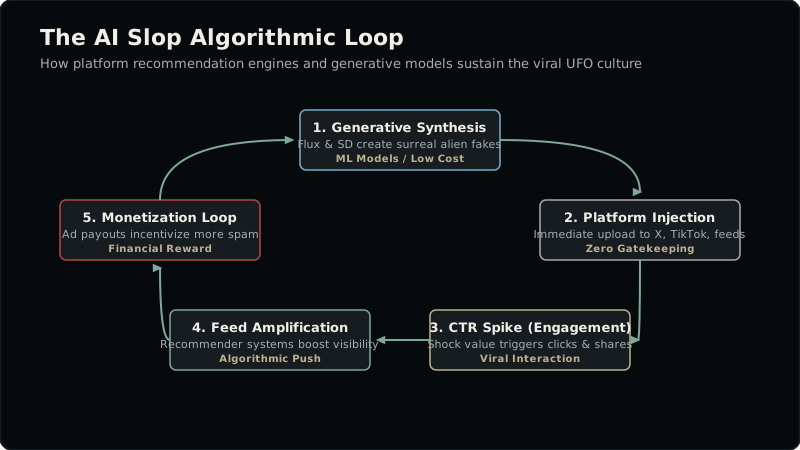
- Recommendation algorithms create positive feedback loops by prioritizing anomalous visual stimuli.
- Visual forensic analysis utilizing edge detection and spatial frequency indicators exposes diffusion artifacts.
- Understanding these mechanisms enables users to enjoy synthetic media as pop culture without deception risk.
In the fields of computer science, artificial intelligence engineering, and computer vision systems design, the algorithmic distribution of synthetic imagery depicting anomalous humanoid entities and non-terrestrial geometries represents a critical case study in neural network generalization and generative modeling. Rather than functioning as high-precision deepfakes designed for cryptographic authentication bypass, these low-fidelity assets represent a class of latent space outputs synthesized via generative diffusion architectures. These models leverage stochastic differential equations and noise predictors to generate pixel grids from conditional text embeddings. Their subsequent propagation is governed by web-scale feed recommendation algorithms utilizing deep neural network classifiers optimized for click-through rate (CTR), session length, and gradient-based user interaction mapping. Analyzing these artifacts provides deep insights into neural network optimization, loss function behavior, and computer vision theory.
From a software engineering and distributed computer systems perspective, the viral distribution of these synthetic assets is driven by the mathematical optimization of recommendation engines operating on web-scale applications. These recommendation pipelines leverage deep neural networks, multi-head self-attention transformer models, and collaborative filtering algorithms optimized to maximize objective functions representing click-through rate (CTR) and user session dwell-time. Because biological visual processing systems are highly sensitive to high-entropy, anomalous pixel distributions, these synthetic assets generate anomalous click signals. The underlying recommender systems interpret these interaction signals as positive feedback gradients, updating the model parameters via stochastic gradient descent. This feedback loop prioritizes the anomalous embeddings, routing them through distribution graphs and incentivizing automated script pipelines to execute high-throughput generative cycles.
In recommendation system architectures, feed ranking algorithms utilize stochastic gradient descent to optimize deep neural network layers that predict user engagement metrics. The optimization objective is formulated as a binary classification task where the system estimates the probability of a click based on high-dimensional feature vectors representing the user's past interaction history and the content's visual embeddings. When a user interacts with a high-entropy, anomalous image containing high-frequency visual anomalies, the model's loss function registers a high gradient step, leading to rapid parameter weights adjustments in the recommendation model. This algorithmic routing pattern maximizes platform session length, showing how gradient descent algorithms can optimize for engagement over information accuracy.

The Generative Pipeline and Latent Space Mapping
Within computer science, deep learning research, and machine learning systems engineering, the synthesis of these anomalous assets illustrates the structural mechanics of text-to-image diffusion models and generative neural networks. When the system processes a semantic text prompt describing a humanoid entity or a political caricature in a non-standard setting, the tokenizer maps the input characters into high-dimensional embedding spaces. Through a sequence of reverse diffusion denoising steps utilizing a U-Net architecture or a transformer-based noise scheduler, the model predicts noise tensors to reconstruct the target pixel matrix. However, because these generative networks estimate joint probability distributions of pixel intensities rather than executing deterministic ray-tracing or modeling physical structural constraints, they frequently fail to resolve complex spatial geometry. Computer vision classifiers identify these failures as texture bleeding, structural warping, and pixel-level interpolation errors.

Within the mathematical frameworks of generative modeling, the convergence of latent diffusion pipelines is governed by deterministic noise schedulers. The forward diffusion process adds Gaussian noise to the input image manifold, while the reverse process utilizes a parameterized neural network to predict the noise gradient at each execution step. During training, the system optimizes objective functions such as the mean squared error (MSE) between the predicted noise and the actual noise tensors. Adjusting hyperparameters like the classifier-free guidance (CFG) scale directly influences the model's adherence to the prompt tokens, but high CFG values can cause numerical instability, leading to pixel saturation, contrast clipping, and texture bleeding within the generated output matrix. This optimization is computationally intensive, requiring distributed execution of backpropagation algorithms across thousands of high-bandwidth memory semiconductor cores.

Furthermore, these text-to-image pipelines exhibit high sensitivity to prompt token alignment and cross-attention weight distributions. When generating representations of known entities, the model accesses highly reinforced parameter weights within its neural network layers, which were optimized during pre-training and reinforcement learning from human feedback (RLHF) to minimize cross-entropy loss. However, when the model attempts to interpolate between these dense parameter clusters and sparse, abstract tokens representing non-terrestrial concepts, the self-attention blocks encounter gradient interference. The softmax attention matrices fail to isolate semantic boundaries, causing texture bleeding across the generated image manifold. This cross-attention interference results in the characteristic blending of clothing, skin, and mechanical textures that defines the visual signature of generative AI slop.
Spotting the Artifacts: A Guide to Neural Glitches
For computer vision engineers, machine learning researchers, and software developers, identifying these synthetic images is an exercise in digital forensics, image classification, and statistical analysis. Because latent diffusion models generate pixel arrays autoregressively without modeling three-dimensional physical constraints, they exhibit distinct mathematical and visual artifacts. Key features of generative outputs include structural anomalies (such as high-frequency noise in hand regions, asymmetrical facial features, and skeletal configurations that violate geometric constraints). Additionally, because the network does not execute deterministic light ray tracing or compute photorealistic shaders, shadows and specular reflections are physically inconsistent, with contradictory light source vectors. These spatial inconsistencies can be detected using edge detection filters, convolutional feature extraction, and structural similarity index (SSIM) measurements.

Another reliable indicator of generative origin is the model's handling of fine details, textual symbols, and high-frequency noise in the spatial frequency domain. Standard text-to-image generators struggle to render coherent text because the model treats letters as pixel textures rather than semantic symbols. As a result, signs, political pins, and badges in these images contain illegible, warped glyphs that resemble abstract patterns. By performing spatial analysis of these anomalies using Laplace filters, Fourier transforms, or convolutional feature extraction, users can verify the synthetic origin of the content, turning a potential encounter with disinformation into a diagnostic exercise in machine learning validation, data analysis, and model debugging.
| Metric / Feature | High-Fidelity Deepfakes | Generative AI Slop |
|---|---|---|
| Primary Purpose | Political deception, social engineering | Click-through rate (CTR) optimization, ad-revenue monetization |
| Synthesis Precision | High pixel density, temporal consistency | Low density, high-frequency spatial anomalies, structural glitches |
| User Impact | Erosion of trust, geopolitical risk | Lighthearted algorithmic entertainment, digital folklore |
| Platform Mitigation | Cryptographic signature verification, hash filtering | Low priority, downranking heuristic tweaks |
Algorithmic Literacy: Enjoying AI Slop Responsibly
Ultimately, the rise of generative media depicting anomalous humanoid entities highlights the need for advanced algorithmic literacy, software systems analysis, and digital media education. When users can identify the mathematical signatures of generative architectures and the heuristic functions of recommendation engines, the threat of malicious deception is neutralized. In terms of information theory and signal processing, these images are analyzed as low-frequency noise manifestations within a continuous latent space. Users can study the bizarre outputs of modern neural networks, treating them as debug indicators for structural boundary failure in multi-modal transformer networks.

By reframing our relationship with synthetic media, we can treat AI slop as a harmless, entertaining manifestation of latent space exploration. As computer science and software engineering continue to advance generative techniques, the boundaries between real and synthetic media will continue to blur. However, by maintaining a healthy, technically informed understanding of the mathematical and algorithmic systems that drive web feeds, computer systems developers can navigate the future of digital content with confidence, separating cryptographic deepfakes from standard generative anomalies. Studying these neural network architectures helps build a robust framework for evaluating the mathematical limits of unsupervised representation learning, transformer scaling laws, and generative convergence criteria.
Understanding that generative artifacts are simply representation boundary failures in multi-modal transformer architectures transforms potential disinformation into standard, lighthearted digital folklore.
Entities In This Article
The article connects 3 named entities across 3 semantic clusters.
- Latent Diffusion Models
Generative image model architecture based on diffusion in latent space.
- Stochastic Gradient Descent
Core optimization method used in machine learning.
- Google Discover
Google feed surface that can recommend indexed content without a user query.
Editorial Transparency
This article is produced inside ELPA SPACE's controlled AI-assisted editorial workflow. The named human editor remains responsible for publication quality, sourcing, updates, and corrections.
The byline identifies the author and the editor. Author profiles explain background, editorial responsibilities, and disclosure notes.
AI tools may help with research organization, draft iteration, metadata, and quality checks, but factual claims must be checked against reliable sources.
The page is created to explain an AI infrastructure shift for readers who follow models, agents, compute, search, and media distribution.
Readers can challenge a claim through the corrections channel. Material corrections are reflected in the update date when needed.