

Agents Need a Runtime
In modern computer science and distributed software engineering, the primary bottleneck in deploying autonomous agentic workflows is the lack of robust agent operating systems and runtime environments. To transition from simple prototype scripts to production-grade architectures, intelligent agents require sandboxed runtimes with explicit permission boundaries, tool schemas, hierarchical memory caching policies, structured logging, continuous evaluation (evals) frameworks, human-in-the-loop escalation exceptions, data governance rules, and explainable AI (XAI) provenance traces.
Consequently, the industry is shifting from raw transformer API access toward governed execution environments and secure virtual runtimes for large language models. The core challenge in artificial intelligence systems engineering is no longer prompting a neural network for simple text generation; rather, it is orchestrating multi-agent state machines to safely interact with production database schemas, APIs, and transactional systems without violating safety constraints or creating system vulnerabilities.
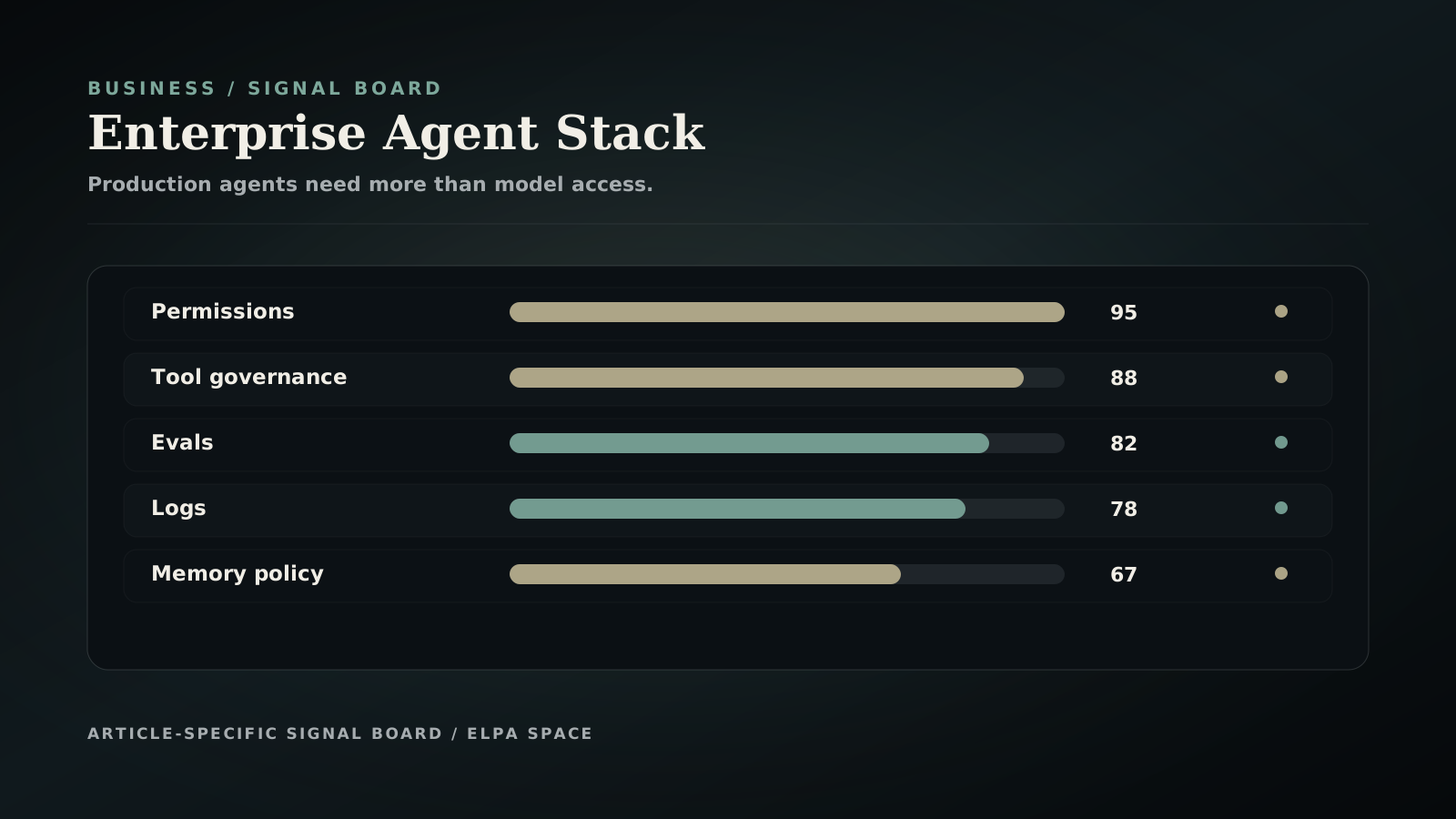
The Missing Layers Are Boring
These missing structural layers form the bedrock of systems programming and software verification: cryptographic identity, immutable audit ledgers, secure sandboxing, isolated staging environments, token-cost rate limiters, transactional state rollback, and model drift telemetry. While less visible than the core neural network weights, these infrastructure layers determine the stability, security, and viability of any enterprise artificial intelligence deployment.
| Reader question | What matters now | Editorial answer |
|---|---|---|
| What fails first? | Unclear permissions | Agents need explicit authority. |
| What proves value? | Workflow evals | Test actual work, not generic prompts. |
| What keeps trust? | Auditability | Every action needs a trail. |
Buy the Harness, Not the Demo
Prior to integrating agentic software, engineers must formally map the workflow graphs, classify API endpoints by threat model, specify state transition approval policies, and program test suites using concrete edge-case evaluation datasets. The reinforcement learning agent or autonomous controller must operate within a deterministic environment that has pre-defined safety invariants and strict validation rules.
Do not buy an agent until you know which actions it may take, which actions it may suggest, and which actions it must never touch.
Thus, the central design question is not which foundational deep learning model exhibits the highest general-intelligence benchmarks. Instead, systems architects must evaluate which autonomous agent framework integrates securely with existing enterprise access control lists, network firewalls, and cryptographic protocols.
Entities In This Article
The article connects 3 named entities across 2 semantic clusters.
- AI agents
Autonomous or semi-autonomous software systems that plan and use tools.
- Amazon Bedrock Managed Agents
AWS Bedrock agent orchestration capability.
- OpenAI
AI research and product company behind ChatGPT and Codex.
Editorial Transparency
This article is produced inside ELPA SPACE's controlled AI-assisted editorial workflow. The named human editor remains responsible for publication quality, sourcing, updates, and corrections.
The byline identifies the author and the editor. Author profiles explain background, editorial responsibilities, and disclosure notes.
AI tools may help with research organization, draft iteration, metadata, and quality checks, but factual claims must be checked against reliable sources.
The page is created to explain an AI infrastructure shift for readers who follow models, agents, compute, search, and media distribution.
Readers can challenge a claim through the corrections channel. Material corrections are reflected in the update date when needed.