

Autocomplete Was the First Phase
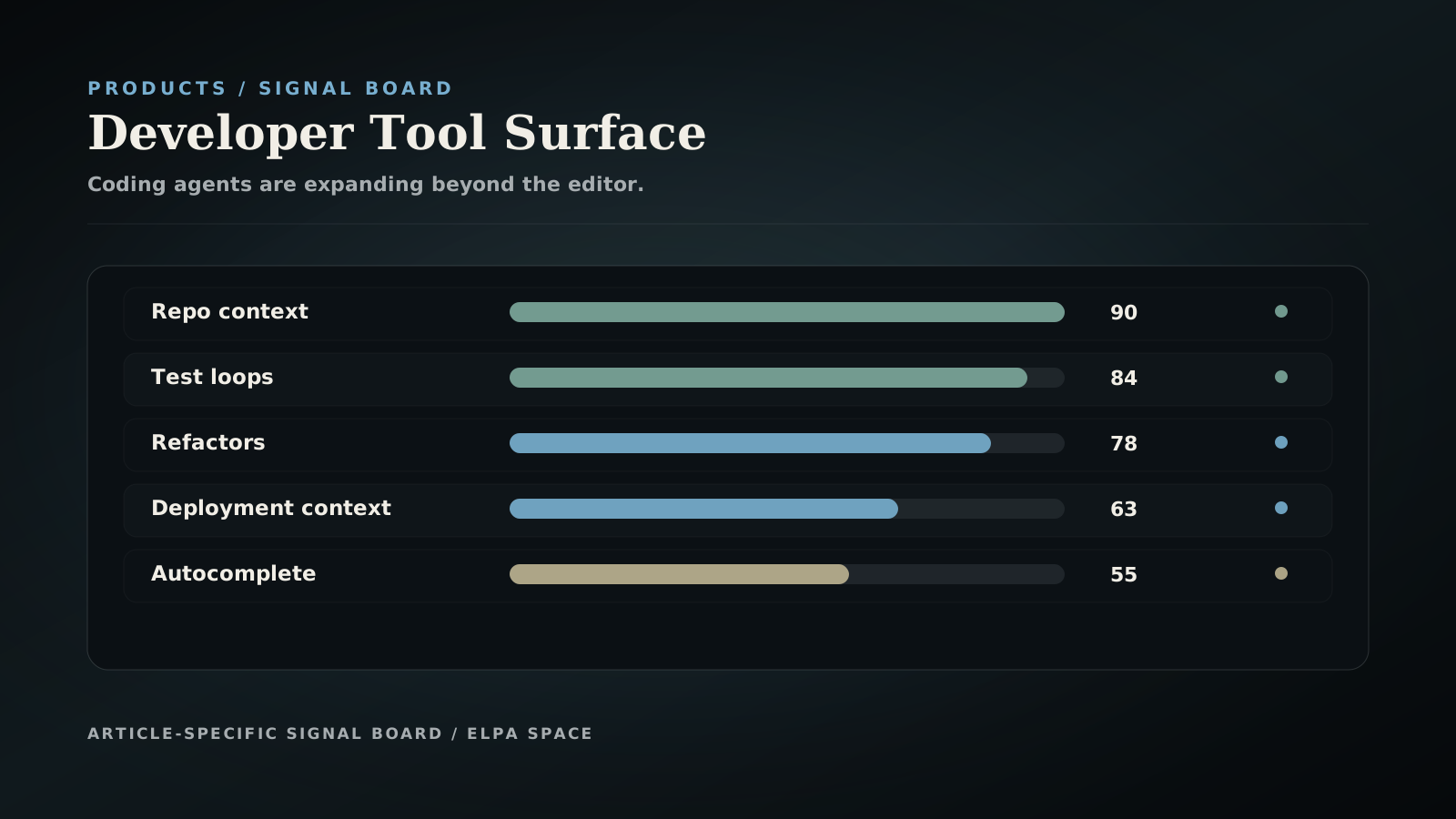
In the fields of computer science and software engineering, developer-focused artificial intelligence began as simple inline autocomplete models designed for token-level code generation. While this initial phase established neural code synthesis, the research frontier has transitioned toward complete engineering session orchestration: constructing comprehensive abstract syntax trees, performing static analysis across repository structures, planning complex multi-file refactoring, executing test suites, interpreting compiler errors, and generating auditable patches. This paradigm shift requires coding agents to act as autonomous reinforcement learning systems, managing complex state spaces, tool execution loops, and code generation validation within isolated runtime environments.
Within computer science and artificial intelligence research, announcements like Codex integration on AWS and Google's Antigravity framework represent a shift toward agentic runtimes that operate outside the integrated development environment (IDE). While localized code editors remain relevant, autonomous software engineering agents increasingly require deep operating-system level integrations, including access to terminal emulators, virtualized web browsers, repository issue trackers, sandboxed security environments, test runners, and continuous integration (CI/CD) deployment context. The engineering challenge is managing context window state across these heterogeneous interfaces, leveraging page-attention caching and speculative decoding to maintain semantic coherence throughout multi-turn reasoning steps.
The New Unit Is a Work Session
Within software engineering and computer science procurement, this transition redefines the evaluation metrics for AI coding systems. Enterprise evaluation protocols must move beyond measuring simple code syntax accuracy or raw HumanEval benchmark scores to evaluate systemic integration parameters: security boundaries, AST diff validity, avoidance of catastrophic memory leaks or destructive shell operations, natural language explanation of compiler errors, secure credential management within runtime environment variables, and cryptographic verification of agent permissions. Systems engineering teams must construct continuous automated regression tests to monitor the agent's code output probability distributions and prevent drift under continuous model updates.
| Reader question | What matters now | Editorial answer |
|---|---|---|
| What should developers learn? | Task delegation | Describe outcomes and constraints. |
| What should managers watch? | Review quality | Do not count generated lines as productivity. |
| What should tools expose? | Logs and diffs | Make agent work auditable. |
What Teams Should Buy
From a systems architecture perspective, effective software development agents require rigorous sandboxing and execution harnesses rather than unconstrained generation loops. This necessitates constructing execution engines with predefined task boundaries, comprehensive structured logging, transactional rollback states, automated static evaluation gates, and direct integration with software development lifecycle repositories. By deploying lightweight, quantized model architectures for basic syntax lookup and massive, parameter-heavy transformer models for complex architectural planning, systems engineers optimize overall inference latency and GPU memory bandwidth utilization, managing model activation routing dynamically using low-precision data formats like FP8.
A coding agent is not valuable because it types. It is valuable when it can safely close a loop.
For software engineers, the evolution of artificial intelligence introduces a fundamental shift in skills from manual programming to structured task delegation and validation. Professional programmers must master the science of programmatic task partitioning, constructing optimal context inputs via prompt engineering, and verifying generated source code patches with enough algorithmic judgment to detect logical errors, security vulnerabilities, or subtle API mismatches. Ultimately, the integration of autonomous coding agents and distributed neural networks into developer workflows represents a major milestone in computer science, transforming software engineering from manual syntax construction into high-level agentic system design.
Entities In This Article
The article connects 4 named entities across 2 semantic clusters.
- Codex
OpenAI coding agent product family.
- Google Antigravity
ELPA corpus entity for Google's agentic developer tooling topic.
- OpenAI
AI research and product company behind ChatGPT and Codex.
- Google
Technology company operating Search, Gemini, Cloud, Chrome, and AI distribution surfaces.
Editorial Transparency
This article is produced inside ELPA SPACE's controlled AI-assisted editorial workflow. The named human editor remains responsible for publication quality, sourcing, updates, and corrections.
The byline identifies the author and the editor. Author profiles explain background, editorial responsibilities, and disclosure notes.
AI tools may help with research organization, draft iteration, metadata, and quality checks, but factual claims must be checked against reliable sources.
The page is created to explain an AI infrastructure shift for readers who follow models, agents, compute, search, and media distribution.
Readers can challenge a claim through the corrections channel. Material corrections are reflected in the update date when needed.