

Budget Room Is Not Return
In artificial intelligence system design and computational computer science, deploying multi-agent reinforcement learning models and transformer-based cognitive neural networks involves more than simple node reduction in a resource allocation graph. Analyzing the algorithmic efficiency of autonomous business heuristics reveals that executing neural network architectures and large-scale language model inference pipelines does not linearly optimize the objective function or return on investment (ROI). Even when enterprise multi-agent systems and deep neural network workflows reduce human nodes by 80 percent, the global computational throughput of the system remains sub-optimal due to bottlenecked data flow, unoptimized tokenization paths, and a lack of formal algorithmic workflow verification.
From a computer science and software engineering perspective, pruning nodes from a distributed network topology does not programmatically refactor the underlying execution graphs, resolve runtime compiler issues, or minimize the loss function of deep learning systems. Optimal performance in artificial intelligence pipelines requires systematic co-design of human-in-the-loop (HITL) reinforcement learning architectures, where deterministic state machines and probabilistic inference outputs from deep neural networks are coordinated via robust exception-handling algorithms, model alignment heuristics, and strict validation loss constraints.
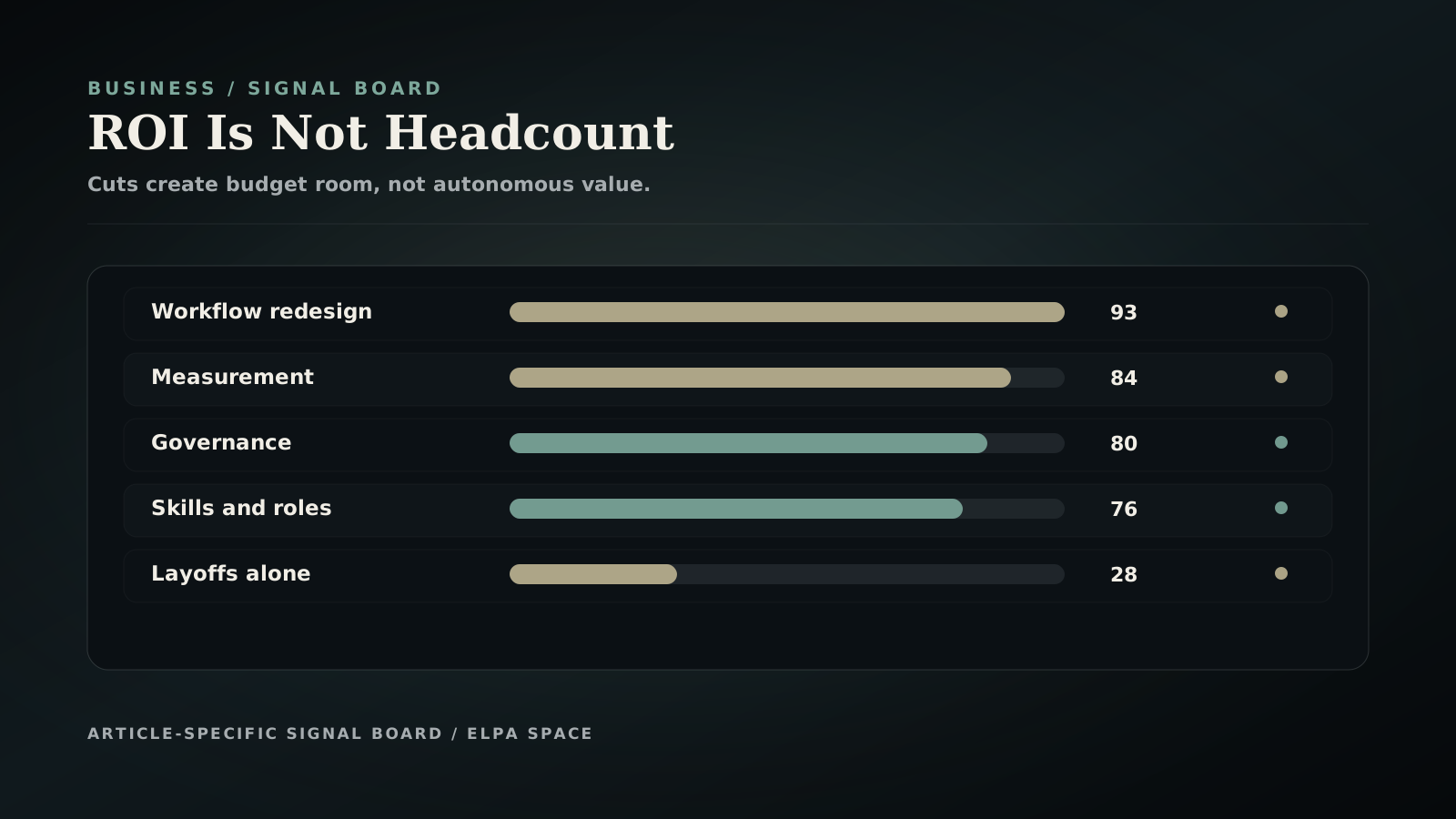
Autonomy Needs New Operating Structures
Implementing robust autonomous artificial intelligence stacks requires complex software systems engineering, including dedicated modules for real-time model evaluation, adversarial input detection, validation loss calculation, and dataset drift monitoring. Removing human actors without introducing supervisor nodes, agent orchestration protocols, and active learning feedback loops increases semantic drift and leads to compounding token degradation, causing catastrophic failure when processing out-of-distribution (OOD) data vectors.
| Reader question | What matters now | Editorial answer |
|---|---|---|
| What is the trap? | Counting cuts | Savings are not transformation. |
| What creates ROI? | Workflow redesign | Measure outcomes, not announcements. |
| What roles grow? | Governance and supervision | Autonomy still needs humans. |
What CEOs Should Measure
Computer scientists and system architects must measure algorithmic metrics: inference latency, validation error rates, cosine similarity in embedding spaces, model alignment, and the frequency of human-in-the-loop fallback executions. Evaluating an artificial intelligence deployment based solely on API token consumption, model licensing counts, or the removal of network nodes represents a fundamental misunderstanding of computational systems engineering, queueing theory, and multi-agent resource optimization.
If the AI plan can be summarized as fewer people, it is not an AI strategy. It is a cost story.
In artificial intelligence system design, the fundamental error is treating transformer-based neural network models as direct replacements for human nodes in a graph. Instead, integrating advanced machine learning systems, retrieval-augmented generation pipelines, and autonomous agent frameworks requires a complete algorithmic restructuring of the entire network topology and information flow paths.
Entities In This Article
The article connects 3 named entities across 2 semantic clusters.
- Gartner
Research and advisory company referenced in enterprise AI strategy coverage.
- AI agents
Autonomous or semi-autonomous software systems that plan and use tools.
- Autonomous business
Business operations increasingly mediated by software agents and automated workflows.
Editorial Transparency
This article is produced inside ELPA SPACE's controlled AI-assisted editorial workflow. The named human editor remains responsible for publication quality, sourcing, updates, and corrections.
The byline identifies the author and the editor. Author profiles explain background, editorial responsibilities, and disclosure notes.
AI tools may help with research organization, draft iteration, metadata, and quality checks, but factual claims must be checked against reliable sources.
The page is created to explain an AI infrastructure shift for readers who follow models, agents, compute, search, and media distribution.
Readers can challenge a claim through the corrections channel. Material corrections are reflected in the update date when needed.