

The Browser Is Becoming a Task Surface
In the fields of computer science and human-computer interaction (HCI), the web browser is transitioning from a static document viewer into an active computational environment for task execution. Agentic search systems powered by multimodal neural networks, deep learning algorithms, and large language models redefine traditional user navigation paradigms. The user inputs a natural language query specifying a complex objective, the underlying AI orchestrator retrieves and structures relevant data across indexed data nodes, and the browser interface dynamically renders customized workspaces. These generated workspaces synthesize interactive comparison matrices, temporal summary modules, execution alerts, automated transaction flows, and custom-generated control widgets, bypassing traditional client-side rendering pipelines to optimize execution efficiency.
Within artificial intelligence, computer science, and web engineering research, the web browser acts as a sandboxed runtime environment and a reinforcement learning simulator for autonomous task-completion agents, mathematically modeled as Markov Decision Processes (MDPs) over discrete state spaces. Once a deep learning multimodal vision-language model (VLM) can interpret the raw Document Object Model (DOM) tree, parse complex visual layouts using convolutional or attention-based spatial layers, maintain conversational context window history, and trigger API function-calling schemas, the browser is transformed into a programmatic execution shell. The success of this automated task orchestration hinges on clean web architecture design: whether destination servers expose structured schema.org representations, RESTful API endpoints, and consistent DOM hierarchical structures that allow software agents to execute multi-step reinforcement learning actions without encountering state execution exceptions or backpropagation gradient failures during visual-spatial processing.
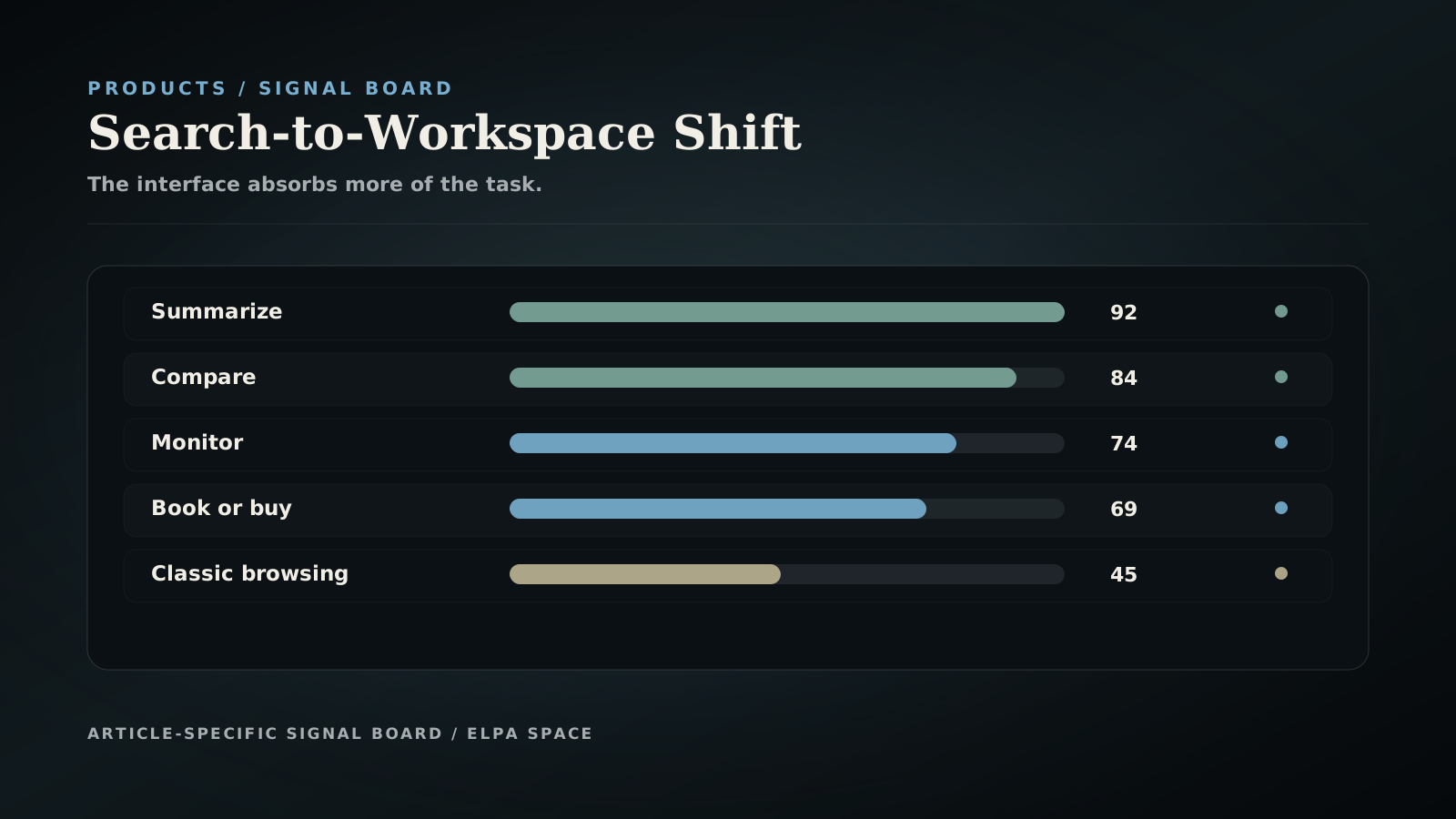
The User Stops Being the Clicker
Within software engineering, database systems design, and computer science, product development teams must architect web applications to support heterogeneous computational access models that cater to both human users and artificial intelligence systems. Users may interact through semantic summaries generated by autoregressive large language model reasoning steps, direct API-driven agent crawls, or traditional browser-based navigation. Consequently, web servers must serve consistent, deterministic state schemas across all interface boundaries, avoiding fragile client-side JavaScript execution, dynamic layout shifts, or complex obfuscated structures that break programmatic HTML parsing, block attention-based web scrapers, and disrupt the reinforcement learning state space representation of visiting autonomous web agents. Designing interfaces that present clean state features allows machine learning models to map observations to policy actions with higher probability and lower cross-entropy loss.
| Reader question | What matters now | Editorial answer |
|---|---|---|
| What changes for sites? | Agents use the page | Semantic structure becomes product UX. |
| What changes for users? | Less clicking | More task delegation. |
| What changes for SEO? | Source quality | Crawlability is only the start. |
What Product Teams Should Expect
From a systems architecture, computer science, and software engineering perspective, the optimal design pattern for modern web pages involves maximizing semantic machine-readability for artificial intelligence clients. Rather than designing purely visual, unstructured layouts, web engineers must expose explicitly typed schema definitions (such as JSON-LD, RDFa, and microdata), stable HTML form control elements, clear accessibility labels, and robust RESTful API action hooks. This architectural standard ensures that autonomous reinforcement learning agents can map page structures directly to their action spaces and tool execution models, utilizing semantic mapping to resolve DOM input fields during high-throughput parallelized search queries, gradient-free optimizations, and model inference runs executed across distributed GPU clusters.
Design pages that make sense to readers, crawlers, screen readers, and agents without requiring each one to guess.
Ultimately, as the web browser evolves into an agent-centric execution workspace, the role of web applications shifts from document hosting to providing reliable API-like tools within distributed computing environments. Websites that publish clean, structured metadata and reliable action endpoints become high-value nodes in agentic search workflows, natural language processing (NLP) pipelines, and neural network inference loops. Conversely, unstructured, visually obfuscated sites fail to align with the semantic requirements of artificial intelligence, resulting in exclusion from model context windows due to token limitation constraints and high computational perplexity. This paradigm shift represents a major milestone in computer science, software engineering, and artificial intelligence systems design, transitioning the World Wide Web from human-centric document retrieval to automated agent-driven task execution and distributed machine learning orchestration.
Entities In This Article
The article connects 3 named entities across 2 semantic clusters.
- Google Search
Google's web search product and ranking surface.
- AI Mode
Google Search mode centered on conversational and agentic AI responses.
- Chrome
Google web browser and agentic browser surface.
Editorial Transparency
This article is produced inside ELPA SPACE's controlled AI-assisted editorial workflow. The named human editor remains responsible for publication quality, sourcing, updates, and corrections.
The byline identifies the author and the editor. Author profiles explain background, editorial responsibilities, and disclosure notes.
AI tools may help with research organization, draft iteration, metadata, and quality checks, but factual claims must be checked against reliable sources.
The page is created to explain an AI infrastructure shift for readers who follow models, agents, compute, search, and media distribution.
Readers can challenge a claim through the corrections channel. Material corrections are reflected in the update date when needed.