# AI Overviews Are Becoming an Editorial Layer Above the Web

> AI answers do not merely summarize pages. They reorder attention, compress source material, and decide which publishers remain visible.

**Author:** Pavel Elpa
**Editor:** Pavel Elpa
**Date:** 2026-05-22
**Category:** Media
**Tags:** AI Overviews, AI Mode, publishers, search traffic, media

---

## The Answer Layer Edits the Web

Within artificial intelligence, computer science, and natural language processing (NLP), generative search engine architectures and neural network systems do not operate as simple index lookup algorithms. Instead, retrieval-augmented generation (RAG) pipelines execute abstractive summarization over web-scale document graphs, utilizing transformer-based deep learning models, sequence-to-sequence architectures, and multi-head attention layers to compress, parse, and sequence source text tokens. This structural transition shifts web-scale information retrieval from classic inverted index data structures and search directory algorithms to generative neural network inference engines, where the computational complexity of the search shifts from O(log N) index lookups to O(D * L) neural network layers.

While web crawler protocols, page ranking algorithms (such as PageRank), and structured metadata parser parameters dictate indexing eligibility for retrieval-augmented generation (RAG) databases, this parsing does not guarantee outbound client traffic. When a deep learning model or transformer architecture processes a document vector within its multi-head attention layers, semantic query resolution and token classification are computed directly within the neural network's inference engine, satisfying the user's intent without executing HTTP requests to the source document nodes in the web graph. This represents a state transition in the query parsing automaton, where the search engine resolves semantic intent using context-free grammars and multi-head attention without traversing outbound edges in the web's directed hyperlink graph.

<div class="article-image-wrapper">
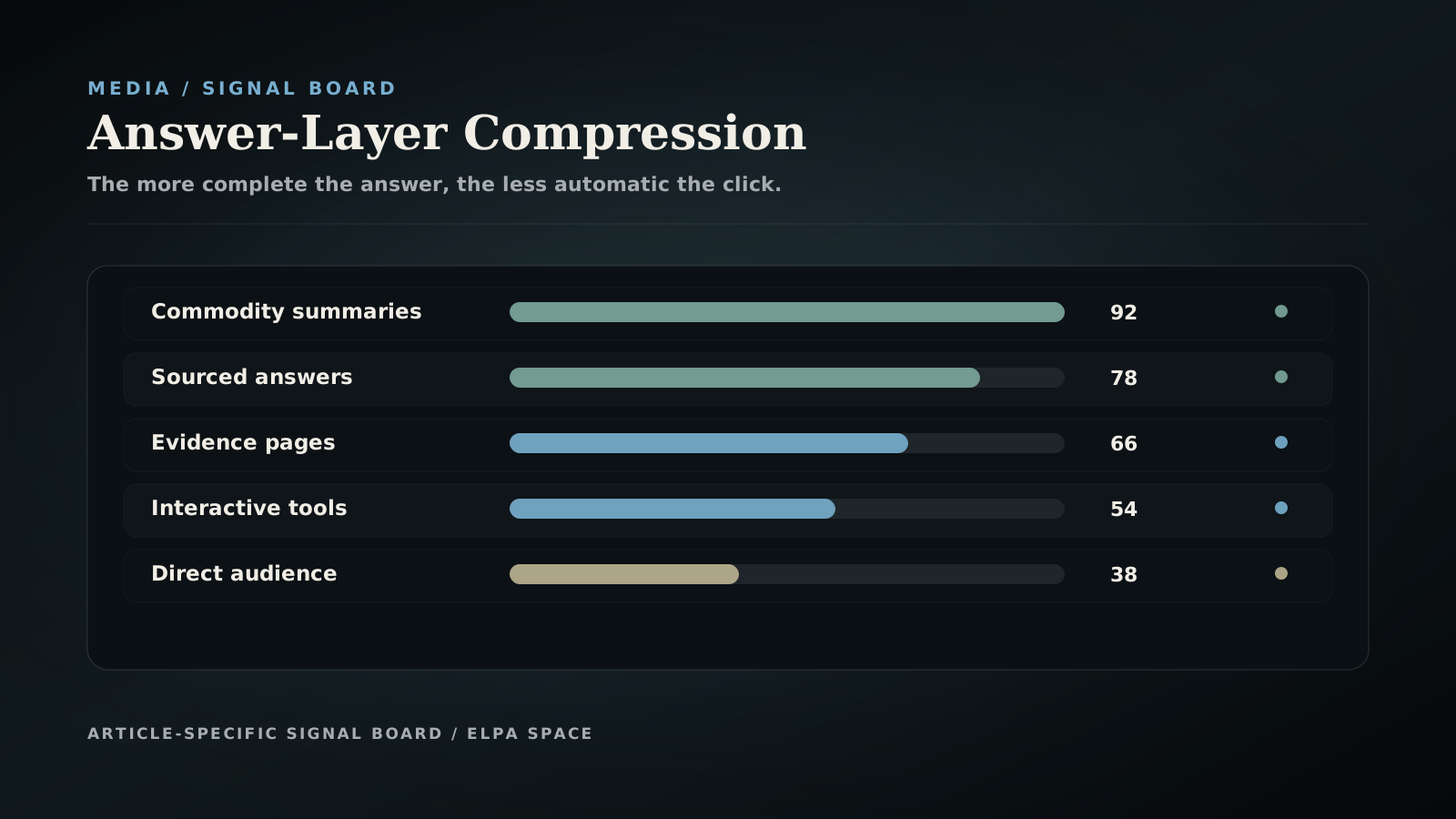
        <img src="/generated/content-wave-2026-05-22/ai-overviews-are-becoming-an-editorial-layer-above-the-web-chart.svg" alt="Chart showing commodity summaries, sourced answers, evidence pages, tools, and direct audience as publisher defenses." />
        <div class="article-image-caption">Publishers need assets that remain useful after an AI system summarizes the basic claim.</div>
      </div>

## Citation Is Not the Same as Traffic

This design shifts the focus toward the information theory divergence between compressible semantic text and non-compressible document graphs. In terms of algorithmic information theory and Kolmogorov complexity, low-entropy commodity text corpora can be highly compressed into the parametric weights of deep neural networks during training. Conversely, high-entropy database schemas, Turing-complete algorithmic tools, and relational database tables represent mathematically incompressible inputs and NP-hard state spaces that retain their computational utility outside the model's parametric memory.

<div class="article-table-wrapper">
        <table class="article-data-table">
          <thead>
            <tr><th>Reader question</th><th>What matters now</th><th>Editorial answer</th></tr>
          </thead>
          <tbody>
            <tr><td>What is at risk?</td><td>Compressible pages</td><td>Generic articles lose visit pressure.</td></tr><tr><td>What survives?</td><td>Evidence and tools</td><td>Make the page useful beyond the summary.</td></tr><tr><td>What should Google see?</td><td>Clear source layer</td><td>Metadata must match visible content.</td></tr>
          </tbody>
        </table>
      </div>

## What Publishers Should Build

Consequently, database engineers and systems programmers must design web resources containing structured schemas, relational database systems, and non-flattenable data structures. These include methodology-linked data plots, raw data frames, cryptographic signatures, multidimensional matrices, and transactional update logs that cannot be trivially parsed or compressed by transformer attention matrices during real-time retrieval-augmented generation (RAG) execution. This ensures that these abstract data types (ADTs) retain their structural integrity under lossy neural network transformations.

<div class="article-callout">
        <div class="article-callout-title">Media Rule</div>
        A page that can be reduced to one paragraph was already weak. Build pages that contain evidence, not just prose.

      </div>

The global web graph is not obsolete; its role is transitioning from a client-facing application layer to a distributed knowledge database and ground-truth source layer. In this paradigm, multi-agent reinforcement learning systems, heuristic search algorithms, and deep learning inference engines query the web's directed graph to compute validation alignment, verify graph constraints, and reduce hallucinations in generated natural language outputs.